A continuous flow intersection (sometimes referred to as a displaced left-turn intersection) improves traffic flow and reduces delays by allowing protected left turns and opposing through movements to occur at the same time. This design safely allows left-turning vehicles to cross to the other side of the through traffic in advance of the main intersection.
How Drivers Navigate a Continuous Flow Intersection
Pedestrians, Heads-Up!
People should watch for signs indicating the direction of traffic and look both ways while progressing through the set of crosswalks, which have signal heads to tell people when to walk or wait.
Caution is needed because drivers will come from either direction as pedestrians navigate from one side of the intersection to another.
Going straight: Drivers proceed through the main intersection as usual when the signal is green.
Turning right: Right turns operate normally. Drivers may turn right when the movement is clear and safe.
Turning left: Left turns occur before the main intersection. Drivers follow the posted signs and pavement markings to cross over the opposing lanes at a signalized crossover typically located 300 to 500 feet ahead of the intersection. After crossing over, they complete the left turn at the main signal when it turns green.
Note: Drivers turning right from the opposite direction will use a free flow lane and typically merge with the through traffic after the intersection.
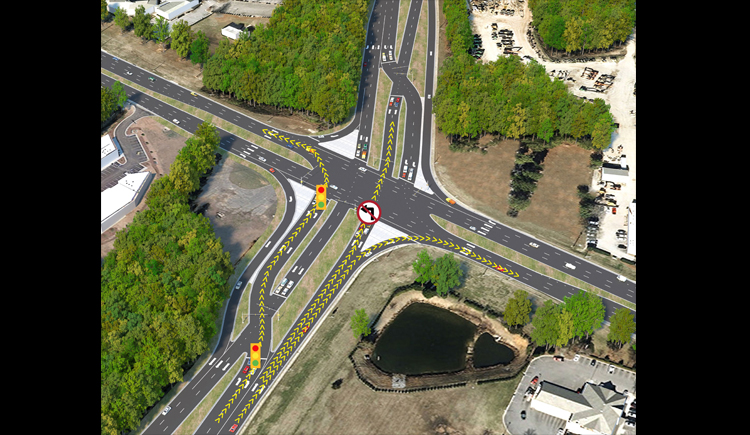
In this design, drivers turn left before they reach the main intersection. This shift allows left-moving traffic and opposing drivers going straight to pass through the main intersection at the same time, reducing travel delays.
Traffic Capacity
Traffic capacity refers to how many vehicles an intersection can efficiently move through in a given period. In general, higher capacity means more vehicles can pass through per hour with fewer delays.
A continuous flow intersection offers the highest traffic handling capacity achievable without building a bridge or grade-separated structure.
Because traditional intersections often experience delays from left-turning vehicles, this design improves efficiency by allowing left turn movements to occur at the same time as opposing through traffic. This reduces the number of signal phases, cuts down on idle time at red lights, and boosts the intersection’s ability to move vehicles smoothly.
This design is also flexible. It can be adapted for T-intersections or configured to improve traffic flow for any — or all — legs of an intersection.
The main intersection and crossover movements are signalized and timed to work together to minimize stops.
Study Indicates Travel Time Savings
A computer simulation study conducted by the Federal Highway Administration showed that a typical continuous flow intersection like the one NCDOT opened in Charlotte in 2019 reduces the average delay to a motorist during rush hour by about 35 percent.
Other Benefits of the Design
- Fewer crash risk locations: The design reduces and spreads out the number of conflict points where crashes can occur. A 2015 Utah Department of Transportation study and a 2021 NCDOT study both found an average 12 percent reduction in crashes with this design.
- Handles heavy left turn demand well: Unlike most traditional intersections, the design performs better when left turn volumes are high, helping traffic move more efficiently.
- Efficient signal placement: Although this design adds traffic signals several hundred feet before the main intersection, these additional signal locations help process large volumes of vehicles, reducing travel delays and improving traffic flow on the corridor. Most drivers typically stop no more than once while traveling through the intersection.
- High capacity without the cost of a bridge: Only a grade-separated bridge can provide higher traffic capacity than a continuous flow intersection. However, bridges require more funding, more construction time, and affect more surrounding property than implementing a continuous flow intersection.
History of Continuous Flow Intersections
The design was introduced in the United States in 1995, and NCDOT opened its first continuous flow intersection at N.C. 16 and Mt. Holly-Huntersville Road in Charlotte in 2019. In 2020, the department received national recognition for this project by winning the top prize, the Grand Conceptor Award, at the ACEC/NC Engineering Excellence Awards.
The department plans to open a second one at U.S. 401 and Mitchell Mill Road in Wake County in the summer of 2026.