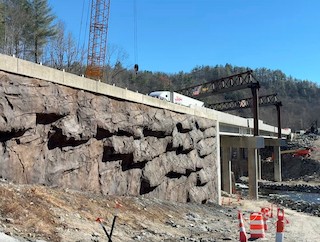
 NCDOT partnered with wildlife agencies to build an innovative bat habitat beside an I-40 bridge in Haywood County.
JONATHAN CREEK –
NCDOT partnered with wildlife agencies to build an innovative bat habitat beside an I-40 bridge in Haywood County.
JONATHAN CREEK – Sometimes, it helps to step away from the workplace to get the creativity flowing.
That’s what happened to Kenny McCourt, an N.C. Department of Transportation resident engineer overseeing a set of bridge replacement projects on Interstate 40 in Haywood County.
McCourt sought ways to address a delicate situation: Roosting boxes that accommodated endangered bats underneath an old Pigeon River bridge near Exit 15 didn’t fit into the new bridge design due to maintenance access needs.
With a little help from his daughter at home, he found a solution that may be replicated across the state and maybe even the nation.
“Me and my little girl, Harper, were sitting around the kitchen table actually watching Animal Planet,” McCourt said. “And I was sitting with the notebook drawing up some ideas on how to take it off the bridge — and it hit me.”
McCourt realized the natural aesthetics NCDOT already planned to incorporate into the side wall that supports the bridge approach could be the answer.
“We took a piece of paper and started drawing these bat habitats right into the Boulderscape wall to give them more of a natural habitat,” he said.
The idea gained traction at McCourt’s office and beyond. Engineers and wildlife experts soon started collaborating to design these roosting spaces for different species — including the endangered gray bat — all built into the new bridge wall for what locals call the High Bridge.
“Bats have been observed roosting in the bridge here crossing the Pigeon River, and the new bridge isn’t going to have suitable roosting habitat like the old one,” said Holland Youngman, a U.S. Fish and Wildlife biologist. “So, we’re putting bat roosts in this retaining wall to give the bats somewhere else to go. I think it’s very new and innovative and creative.”
This project brought together NCDOT, contractors, U.S. Fish and Wildlife, the N.C. Wildlife Resources Commission, prime contractor Kiewit Construction, sub-contractor Boulderscape and others. Everybody added their expertise to think and build outside the box.
Crews from Kiewit used excess materials to shape and build the small habitats before a Boulderscape crew added a layer of shotcrete to the outside. It’s now a space these bats can call home.
“This has been a phenomenal collaboration just to make sure we’re all on the same page,” said Katherine Etchison, wildlife diversity biologist with the N.C. Wildlife Resource Commission. “We can all brainstorm and give our ideas about how this should go together.”
Within days of installing the roosting holes, several bats flew in to explore the new space, including an endangered gray bat. Harper, McCourt’s daughter, named the first one to visit, “Smokey.”
Most species have migrated for the winter to locations in Tennessee and will return in the spring. Before then, NCDOT will add a half-acre flower bed near the bridge, full of native flowers that bloom at night and attract insects — bat food.
"A project as successful as this — for the bats, for our bridge maintenance teams, for our construction team and wildlife partners — is something that I can see growing in western North Carolina, across the state and when word gets out, across the country," McCourt said. "It's pretty cool that so many folks are supportive of thinking outside the box."